


Programme
Society of Editors Media Freedom Conference
March 17, 2026
Leonardo Royal Hotel, London
8-14 Cooper’s Row, London EC3N 2BQ
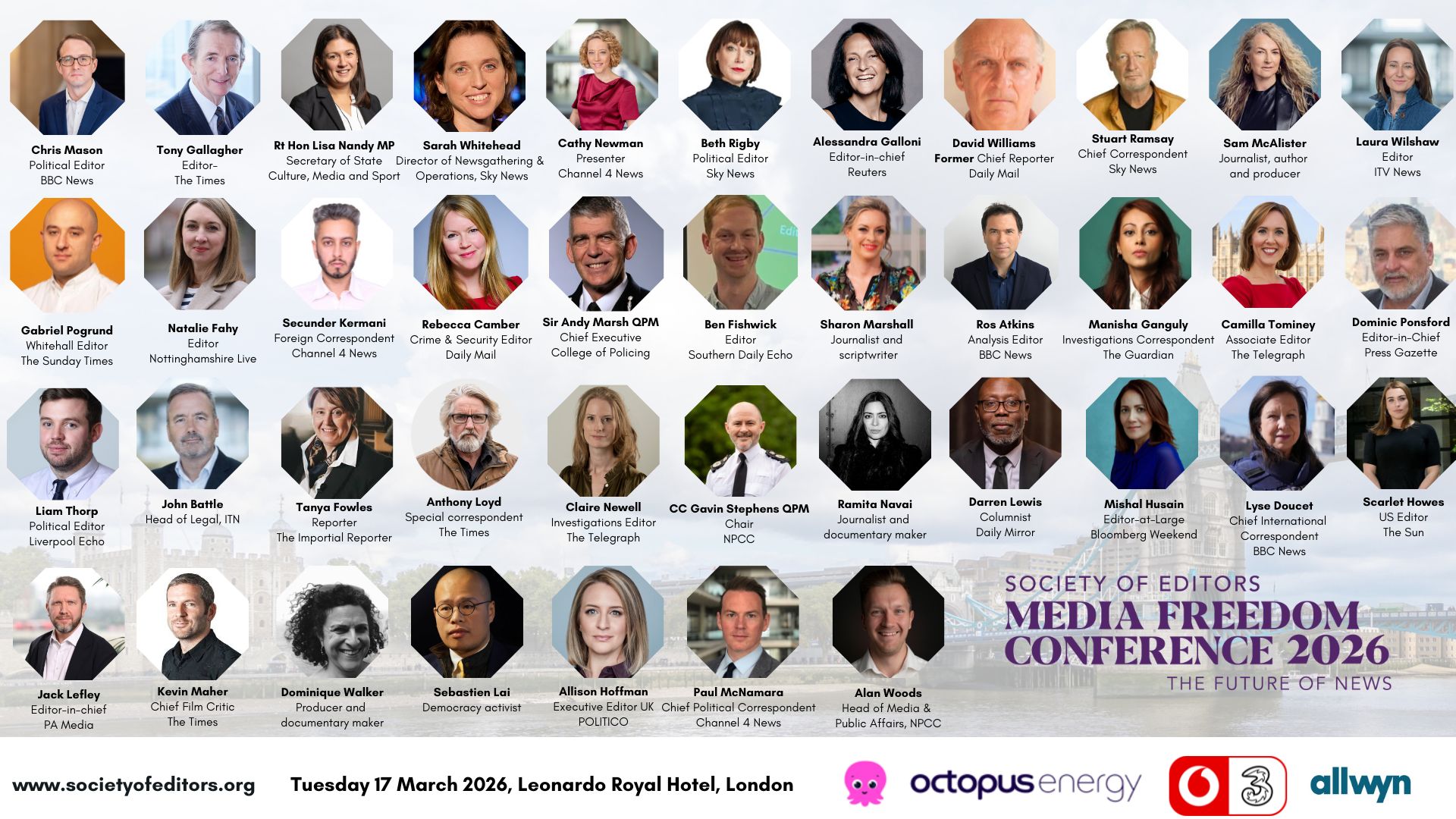
Programme listed below with more to follow. Timings are subject to change.
8.30 – 9.10 am Coffee and Registration
9.10 am Welcome from Sarah Whitehead, President of the Society of Editors and Director of Newsgathering and Operations, Sky News
9.15am Welcome from Dawn Alford, Chief Executive, Society of Editors
9.20am Policing and Media Announcement
Intro by: Rebecca Camber, Chair, Crime Reporters Association and John Battle, Head of Legal and Compliance, ITN
Panel discussion chaired by Rebecca Camber
John Battle, Head of Legal and Compliance, ITN
Ben Fishwick, Editor, Southern Daily Echo
Sir Andy Marsh, Chief Executive, College of Policing
Chief Constable Gavin Stephens QPM, Chair, National Police Chiefs’ Council
Alan Woods, Head of Media and Public Affairs, NPCC
10.10 am Perception vs Reality: How Film, TV and Popular Culture Shape Public Attitudes to Journalism
Public understanding of journalism is shaped not only by news coverage but how journalists are portrayed in film, television and popular culture. This panel examines how those portrayals influence assumptions about motivation, ethics, intrusion and trust, and why those narratives can matter for real-world journalism.
The discussion will explore what these portrayals get right, what they miss, and how editors might better communicate the realities of journalism to audiences and whether popular culture helps or harms trust.
Chaired by: Kevin Maher, Chief Film Critic, The Times
Panellists:
Scarlet Howes, US Editor, The Sun
Sharon Marshall, Journalist and Author
Sam McAlister, Producer and Author
Dominic Ponsford, Editor-in-Chief, Press Gazette
Dominique Walker, Producer and documentary maker
11.10am Coffee
11.30am Reporting War in the Age of Disinformation: From OSINT to the Front Line
Covering conflict has become more complex, more dangerous and more contested. This session looks at how war reporting is changing in an environment shaped by propaganda, online manipulation, and competing narratives.
Panellists will discuss verification under pressure, the growing role of OSINT, decisions around speed versus certainty, and the responsibilities newsrooms carry when reporting from or about conflict zones. Delegates will take away insight into how editorial judgement, safety considerations and audience expectations are evolving.
Chaired by: Lyse Doucet, Chief International Correspondent, BBC News
Panellists:
Secunder Kermani, Foreign Affairs Correspondent, Channel 4 News
Anthony Loyd, Special Correspondent, The Times
Ramita Navai, Journalist and documentary maker
Stuart Ramsay, Chief Correspondent, Sky News
12.20 pm Video address
12.40 pm Networking Lunch
1.40pm Investigations & Campaigns: Why They Matter, How to Fund Them, and How They Change Lives
Investigations and campaigns remain among journalism’s most powerful tools, but they are increasingly difficult to sustain. This panel focuses on the practical realities of funding, resourcing and protecting investigative work in modern newsrooms.
Panellists will debate how investigations are prioritised, how collaborations can reduce cost and risk, how legal and operational challenges are managed including the realities of what can be achieved across different newsroom sizes and budgets.
Chaired by: Claire Newell, Investigations Editor, The Telegraph
Panellists:
Tanya Fowles, Local Democracy Reporter, The Impartial Reporter
Manisha Ganguly, investigations correspondent and open source lead, The Guardian
Liz Lane, Digital Investigations Editor, Sky News
David Williams, former Chief Reporter, Daily Mail
2.30 pm Trump, Power and the Press: What US Politics Means for UK Newsrooms
US politics has become a stress test for the relationship between power, media and audiences. This session uses the American experience as a case study in how political power can seek to control access, shape narratives and challenge the authority of journalism, particularly in a highly polarised and global media environment.
Rather than focusing on UK political reporting mechanics, the discussion will explore what it is like to report from the White House, how newsroom culture and decision-making have changed under sustained pressure, and how editors respond when political coverage itself becomes part of the story. Panellists will debate which lessons are transferable to the UK, which are not, and how newsrooms can prepare for similar pressures without losing editorial independence or credibility.
Chaired by: Mishal Husain, Editor at Large, Bloomberg Weekend
Panellists:
Allison Hoffman, Executive Editor, POLITICO
Darren Lewis, Columnist, Daily Mirror
Paul McNamara, Senior Political Correspondent, Channel 4 News
3.20pm Coffee break
3.40pm Keynote address – Rt Hon Lisa Nandy MP, Secretary of State for Culture, Media and Sport
4.00pm Reporting Politics in the UK: Holding Power to Account in a New Era
Political journalism is being reshaped by tighter message control, managed access, platform-driven narratives and increasingly sceptical audiences. This session looks at how political reporting is changing at national and regional level, and what editors need to do to retain authority and relevance.
The panel will debate access versus scrutiny, how to avoid becoming reactive or agenda-led, and how political journalism can better reach diverse and wider audiences.
Chaired by: Camilla Tominey, Associate Editor, The Telegraph
Panellists:
Aubrey Allegretti, Chief Political Correspondent, The Times
Maria Breslin, Editor, Liverpool Echo
Sam Coates, Deputy Political Editor, Sky News
Gabriel Pogrund, Whitehall Editor, The Sunday Times
4.45pm The Editors’ Panel: The State of News 2026: Power, Pressure and the Future of Journalism
The conference closes with a candid conversation between high-profile and experienced editors on the realities of leading newsrooms today and the challenges ahead. This session will explore the pressures shaping editorial decision-making, including financial constraints, changing newsroom structures, audience trust, journalist safety and the impact of new technologies.
Editors will debate whether diversity initiatives are delivering meaningful change, how news organisations are supporting and protecting journalists in increasingly hostile environments, and how newsrooms are experimenting with new platforms and formats to reach and engage audiences. The discussion will focus on what is working, what is not, and what needs to change if journalism is to remain resilient, relevant and trusted in the years ahead.
Chaired by: Ros Atkins, Analysis Editor, BBC News
Panellists:
Natalie Fahy, Editor, Nottingham Post
Alessandra Galloni, Editor-in-Chief, Reuters
Jack Lefley, Editor-in-Chief, PA Media
Laura Wilshaw, Editor, ITV News
5.30pm Fellowship Award
Fellowship Presentation to Tony Gallagher, Editor, The Times
5.45pm Drinks reception
6.30pm CIoJ Young Journalists Awards 2026